I strongly disagree. As someone who broadly detests religion, I know that the mere act of praying can act as self-confrontation that is otherwise inaccessible in many cases.
There are secular alternatives. SMART Recovery is secular and can be used in place of AA if a substance abuse program is court ordered AFAIK. I attended a few meetings on my own and had a few people that were court ordered show up there
I think it’s important. Most of the people in AA aren’t religious, but the “program” wouldn’t survive if it lacked structure. People use the religious terminology, but most of them don’t believe it.
It’s not an effective program and shouldn’t survive. Telling people they’re powerless and only God can save them is the opposite of what should be said.
Having community support to hold each other accountable is a massive barrier for many people struggling with addiction. The term codependency was coined in addiction recovery research — not in the way its often colloquially used, though. People dependent on substances very likely have someone that is codependent around them enabling that addiction. Some programs like SMART Recovery specifically host separate meetings for family and friends of people seeking treatment to break down those dynamics.
For some, AA is the only option out there, but I do suggest people looking for secular options to check out SMART Recovery. They have workbooks and a mobile app that include evidence based skills, but if someone’s in need of an in-person community and doesn’t have any alternatives around them, I think it’s reasonable to support them in going to AA, if only to check it out and see what the particular groups are like. Another commenter in this thread (BanMe) shared their experience in finding a group that was filled with atheists, so, they’re not all submitting to Jesus
Also want to throw out there for anyone curious about specific skills, DBT also has quite a few centered around distress tolerance, mindfulness and emotional regulation. They’re helpful in quite a few areas outside of addiction, but DBT is considered like gold standard treatment for people with chronic suicidality. It’s not effective for everyone, though. There’s no one model that will work for everyone. Treatment for mental health, substance abuse included, is highly individualized and has many factors in how each model might be effective or not.
Doing nothing doesn’t do a damn thing. It should be one tool in a toolbox. AA is not like the other things on there, just like CBT isn’t like those things, just like medication isn’t like those things. GP1s just landed in the medication toolbox. Addiction is incredibly complex and includes a spiritual component. If you don’t like how the program does it, go start your own alcohol treatment protocol, hell a global network of meetings and instant support, and see how far you get. I’m super eager to see it.
I’ve already mentioned this in another comment, but SMART Recovery is a secular alternative that does host virtual sessions if anyone’s looking and can’t find something local. They’re pretty well established in multiple countries now. They’ve also got the website and mobile app with evidence based skills. DBT also has skills targeting addiction. The main reason I think AA can be effective (though its less than a coin flip chance iirc) is due to the community aspect.
My logic is just fine. Im wondering how yours are, if you think science is the only way to understand if something is useful to a human being.
The entire field of spirituality and religion is very important for a lot of people because it gives them meaning. Science would say thats just useless. I disagree. It has a lot of meaning for a lot of people.
I’m confused what you’re saying science would say is useless. Having meaning? Cuz that’s well supported in psychology. There are many ways to develop meaning in our lives. Science is just a method that helps us figure out what is effective. Spirituality can be effective in helping to form meaning, sure, but people need alternatives if or when it fails.
Science would say spirituality is useless, even ridiculous, because it cant find evidence for a soul.
Science can probably measure how our brains respond to spirituality though, and say that its useful because our brains respond to it in a positive way.
Again though, science is a tool. I’m not sure where you’re getting this idea that “science would say [spirituality is] useless.”
Also yes, there are studies showing some respond positively. Not everyone. I turned to atheism after decades of screaming to a god that I’ve determined doesn’t exist to help me — so yeah, it’s useless and was even negative in effect for me. But there are hypotheses that holding affirmative beliefs on it has been an evolutionary trait passed down to help the species survive, because we like having answers and what happens after death can’t be answered. Which goes to your point about how we can’t necessarily find evidence for everything we might have questions on. If we can’t find answers we may make things up to quell the discomfort the lack of one can bring to maintain reason to keep living.
I have a friend who I sometimes discuss these things with. He has exactly the same view as you here - traits being passed down to help the species survive. You know why its the same? Because this is what science says about it. And if you read science, you will believe the same things. Its not even your own thoughts.
I just find that interesting. But I also realize the same can be said for spirituality. If you ask someone what they believe, its always a carbon copy of what is popular to believe in those circles.
I mean. Again. We’re pattern seeking creatures that like having answers. We developed a method that updates based on new information, replication and peer review. I provided one hypothesis that I’m not even wedded to. I just think its an interesting idea. If you have alternative explanations or ideas I’m open to them, whether they can be tested or not. It’s just my preferred method since it’s more likely to provide meaningful results in my day to day life.
Im pretty sure op said that. He said the religious aspects of AA help some ppl and they’re right. The issue is ppl act like their arent a-religious alternatives which their clearly are


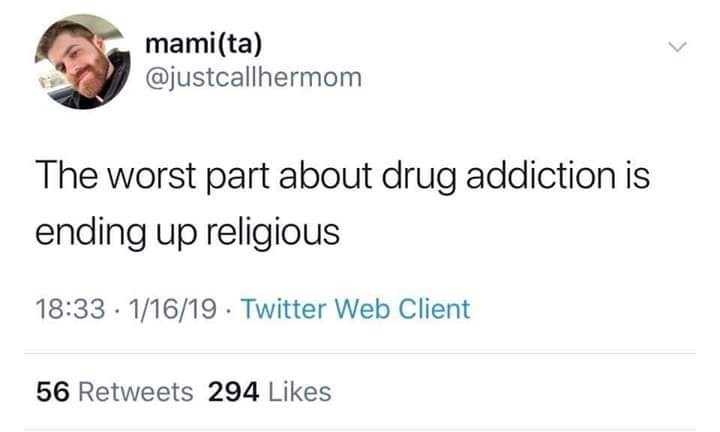
The state should be barred from imposing religious indoctrination/pseudo-science (12 steps, etc) as a “cure” for addiction.
I strongly disagree. As someone who broadly detests religion, I know that the mere act of praying can act as self-confrontation that is otherwise inaccessible in many cases.
The state still shouldn’t be able to force it as a punishment.
I somehow missed the first part of your comment. I agree, a secular alternative should be available.
There are secular alternatives. SMART Recovery is secular and can be used in place of AA if a substance abuse program is court ordered AFAIK. I attended a few meetings on my own and had a few people that were court ordered show up there
I think it’s important. Most of the people in AA aren’t religious, but the “program” wouldn’t survive if it lacked structure. People use the religious terminology, but most of them don’t believe it.
It’s not an effective program and shouldn’t survive. Telling people they’re powerless and only God can save them is the opposite of what should be said.
There are far more effective methods out there
Having community support to hold each other accountable is a massive barrier for many people struggling with addiction. The term codependency was coined in addiction recovery research — not in the way its often colloquially used, though. People dependent on substances very likely have someone that is codependent around them enabling that addiction. Some programs like SMART Recovery specifically host separate meetings for family and friends of people seeking treatment to break down those dynamics.
For some, AA is the only option out there, but I do suggest people looking for secular options to check out SMART Recovery. They have workbooks and a mobile app that include evidence based skills, but if someone’s in need of an in-person community and doesn’t have any alternatives around them, I think it’s reasonable to support them in going to AA, if only to check it out and see what the particular groups are like. Another commenter in this thread (BanMe) shared their experience in finding a group that was filled with atheists, so, they’re not all submitting to Jesus
Also want to throw out there for anyone curious about specific skills, DBT also has quite a few centered around distress tolerance, mindfulness and emotional regulation. They’re helpful in quite a few areas outside of addiction, but DBT is considered like gold standard treatment for people with chronic suicidality. It’s not effective for everyone, though. There’s no one model that will work for everyone. Treatment for mental health, substance abuse included, is highly individualized and has many factors in how each model might be effective or not.
It works for some people, so its useful. You can call it pseudo science if you want, nobody cares if its science. They just want something that works.
“it works for some people”
So does lobotomy
So does electroshock therapy
So does sleep deprivation
So does solitary confinement
So does brain washing
… and so on. They all “work for some people”. They are all “useful”.
Not a good barometer for success. Your logic is horrifying.
None of the aforementioned should be a tool of the state (including AA)
Doing nothing doesn’t do a damn thing. It should be one tool in a toolbox. AA is not like the other things on there, just like CBT isn’t like those things, just like medication isn’t like those things. GP1s just landed in the medication toolbox. Addiction is incredibly complex and includes a spiritual component. If you don’t like how the program does it, go start your own alcohol treatment protocol, hell a global network of meetings and instant support, and see how far you get. I’m super eager to see it.
I’ve already mentioned this in another comment, but SMART Recovery is a secular alternative that does host virtual sessions if anyone’s looking and can’t find something local. They’re pretty well established in multiple countries now. They’ve also got the website and mobile app with evidence based skills. DBT also has skills targeting addiction. The main reason I think AA can be effective (though its less than a coin flip chance iirc) is due to the community aspect.
My logic is just fine. Im wondering how yours are, if you think science is the only way to understand if something is useful to a human being.
The entire field of spirituality and religion is very important for a lot of people because it gives them meaning. Science would say thats just useless. I disagree. It has a lot of meaning for a lot of people.
I’m confused what you’re saying science would say is useless. Having meaning? Cuz that’s well supported in psychology. There are many ways to develop meaning in our lives. Science is just a method that helps us figure out what is effective. Spirituality can be effective in helping to form meaning, sure, but people need alternatives if or when it fails.
Science would say spirituality is useless, even ridiculous, because it cant find evidence for a soul.
Science can probably measure how our brains respond to spirituality though, and say that its useful because our brains respond to it in a positive way.
Again though, science is a tool. I’m not sure where you’re getting this idea that “science would say [spirituality is] useless.”
Also yes, there are studies showing some respond positively. Not everyone. I turned to atheism after decades of screaming to a god that I’ve determined doesn’t exist to help me — so yeah, it’s useless and was even negative in effect for me. But there are hypotheses that holding affirmative beliefs on it has been an evolutionary trait passed down to help the species survive, because we like having answers and what happens after death can’t be answered. Which goes to your point about how we can’t necessarily find evidence for everything we might have questions on. If we can’t find answers we may make things up to quell the discomfort the lack of one can bring to maintain reason to keep living.
I have a friend who I sometimes discuss these things with. He has exactly the same view as you here - traits being passed down to help the species survive. You know why its the same? Because this is what science says about it. And if you read science, you will believe the same things. Its not even your own thoughts.
I just find that interesting. But I also realize the same can be said for spirituality. If you ask someone what they believe, its always a carbon copy of what is popular to believe in those circles.
I mean. Again. We’re pattern seeking creatures that like having answers. We developed a method that updates based on new information, replication and peer review. I provided one hypothesis that I’m not even wedded to. I just think its an interesting idea. If you have alternative explanations or ideas I’m open to them, whether they can be tested or not. It’s just my preferred method since it’s more likely to provide meaningful results in my day to day life.
Im pretty sure op said that. He said the religious aspects of AA help some ppl and they’re right. The issue is ppl act like their arent a-religious alternatives which their clearly are