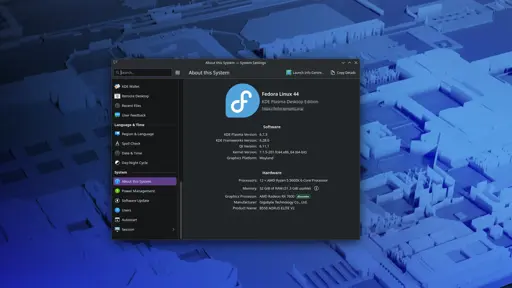
Two years into full-time Linux and I’m finally burning the distro-hopping cycle. I fell for the Arch/AUR trap for a while, but I got tired of spending my weekends debugging file manager crashes instead of maintaining my home lab.
Switched back to Fedora, and it’s boring in exactly the way I need it to be. It’s a stable launchpad for my projects, not the project itself.
Don’t get comfy, I used to be fedora, then debian, then arch. Mint + Cinnamon is my final resting place.
I fell for the Arch/AUR trap for a while, but I got tired of spending my weekends debugging file manager crashes instead of maintaining my home lab.
What sort of file manager crashes were you having?
Right mouse click, it was an intermittent issue and never did get to the bottom of it as the only forum posts I could find were from 10 years ago. Yes I know I could of used the keyboard shortcuts but my muscle memory is more mouse orientated than keyboard lol
Luckily for me, I switched from Cachy to Fedora kde right before the AUR attacks started happening. Fedora honestly feels like home to me now. I customized it to have a very Gnome like workflow, and its working flawlessly for me.
Why not fedora gnome? 🤔
I’ve recently had some issues with Fedora (KDE). After I install any update it tells me to restart to finish installing. So I restart and it still tells me the same thing. Probably time I distrohop again.
With the usual restriction of “either upstream or Mint, otherwise you’re doing it wrong”. There are 6 options. Ubuntu is obviously out. Arch is not my cup of tea. Fedora is already ruled out. Debian/Mint aren’t as secure as Fedora/OpenSUSE. That leaves me with going back to OpenSUSE Leap.
But the proprietary media codecs on OpenSUSE come from the AUR … looks like I’m out of options.
This might not be your issue, but I remember for me there’s this button in the tray that appears after all updates are downloaded. You click it and there’s an option to restart and update. If you just go to the main menu to restart, it doesn’t always show this “restart and update” option, and just restarts without installing the updates. Though even if you make this mistake you shouldn’t need to re-download the updates. Just go to KDE Discover and check for updates again, and the button will appear in the tray again. I think.
Also maybe you’d like the Fedora atomic distros, like Bazzite or Aurora. Unlike installing the updates during reboot, they install them in a “disabled state” while the system is running. Then you reboot and it automatically boots to the new version, no need to wait for any installation. What’s neat is that it’s really hard to break. Even if you pull the power while it’s installing updates, it will just use the previous version and try installing again. No risk of corruption.
What’s the security issue with Debian and Mint? Debian is usually my goto but I don’t want to expose myself to security issues
Linux in general is not secure for desktop users. There’s basically never sandboxing, and when there is it’s usually weak, antivirus is rarely used, and developers aren’t vetted as stringently as with paid software. Apparently Fedora and OpenSUSE take these issues more seriously, and SE Linux does somewhat restrict what malicious things a piece of software can do.
It’s a pretty widely held view that Fedora and OpenSUSE are more secure than Debian, Ubuntu, and Arch for desktop users but I’m not really an expert so I’m mostly retroactively justifying what I’ve heard second-hand.
There’s also https://secureblue.dev/
I got fed up with Discover’s whole reboot-to-update thing and just disabled it.
Eventually, I ended up just disabling updates through discover altogether, I’d rather just use my little bash script anyways.
With LUKS the whole “reboot to update” thing is 1000 times as inconvenient. I set it to install updates immediately, and even automatically, but the update process just isn’t going great for me in a bunch of ways.
Removed by mod
Debian on my severs and workstation. My laptop is also Debian, though I have a Haiku partition that has been a lot of fun to play around with. It’s way, way better than the last time I tried it.
Debian for everything.
Yes ! I don’t get why debian always seems to be forgotten outside of its server use. I have been running it for 2 years now (homelab, laptop and desktop).
Beyond none of its branches actually satisfying my preferences, I feel like the way it handles major version upgrades is way too involved. I suppose it makes sense; it’s paying back the accumulated debt of a couple years worth of bliss…
Having said that, my experience on Fedora Atomic is (almost) equally blissful without requiring any of that whenever a major version update strikes.
Don’t get me wrong; I definitely do believe Debian has its uses on desktop Linux. But I can’t shake off the feeling that they’re definitely more niche compared to say Fedora.
The upgrade issue is exactly why I don’t like Debian-based distros for my desktop
I love Debian, I use it as a desktop and it’s installed on all my machines, but it has some problems/quirks that make it hard to recommend it for desktop usage.
First one is that it doesn’t have sensible defaults, the OS expects a user who is an admin, one who will configure things to their liking. I would consider this to be a feature, if it weren’t for the second problem, the documentation. The documentation is wayy too dated, lots of pages in the wiki haven’t been updated since Debian Buster days!
A better recommendation would be probably a Debian derivative like MX Linux. They are more opinionated, but as far as I know, they come with better defaults and offer newer guides, documentation, etc.
Removed by mod
Debian is nice & boring, but I have had issues with how old its kernel and software versions are. 6.12 isn’t too bad for Trixie, but previously it was really terrible. When I was running Bookworm, I ran into plenty of situations where software I was compiling or getting from outside the repos (for niche software), wasn’t backwards compatible to the library versions Debian provided.
No hate for Debian, but it just doesn’t work for a lot of people. However, these days I would go for Debian over Ubuntu 10 times out of 10.
That is a release engineering issue on the developers side in my opinion though no less real. Developers targeting Linux should target the current version of big LTS releases like debian and Redhat enterprise if they are serious about compatibility beyond “works on my system”
For the vast majority of computer users I’d says debian is fine since most users hardly step out of the browser these days.
Debian for everything I need to not fall over, CachyOS for computers I want to fiddle with.
If you like to fiddle, I might suggest Arch. 😁 Hit me up if you want help with getting started!
CachyOS is Arch with a few tweaks, some of which are hard to do by yourself.
Fair enough. I thought it was one of those distros that you couldn’t change much once installed. My bad, if incorrect.
You probably think of Bazzite. Same gaming focus, but on immutable base, also very popular :)
No I was thinking of CachyOS, I just incorrectly thought it was immutable. 😊
Yeah, I tried pure Arch first, fucked up by not installing the right drivers for my old Nvidia card, and was never able to really get it running properly. So I gave up and tried CachyOS instead, on the basis that it’d probably get the drivers right for me. And it did.
I’d come with a word of caution then - while CachyOS automatically and conveniently installs with correct defaults, it is still a direct Arch derivative. Going forward, it will be just as easy to screw the system up and not know where to go next.
With that said, I strongly advise to learn to revert any change you can make to your system. The simplest way (assuming CachyOS installed root filesystem as btrfs) is to learn your way around snapper early on. Check tutorials on how to do it right on CachyOS.
With Snapper set up well, you can essentially undo any change. And this will be essential as you learn Arch (which CachyOS still really is).
Removed by mod
CachyOS anyone?
For gaming, oh yes. And enable snapshots so you can rollback to a working version if the latest update shits the bed.
My partner isn’t IT-literate but loves her CachyOS since it means not having to deal with Windows
I did the same thing. Settled om Baazite
Bazzite is just right for my daily driver. I was hopping around different arch distros for a while, but I had some really weird encounters with btrfs and not being able to recover after kernel upgrades. Happened to me 3 times in the span of 2 years.
Me too, on all my desktop PCs. Aurora on my work laptop. Ublue rocks.
I have been on this Linux jam since 1996 with a CD copy of Red Hat that came with a magazine (Byte, maybe?). In 2018 I made the jump to Debian based distros specifically because I got tired of the surprises. Now my lab runs LMDE. The only thing more stable and boring is Debian Stable itself.
Like you said, I want to focus on my projects, not have the OS be my project.
it’s kind of strange hearing about all this stability and everything on debian stable (and lmde by extension), when it was constantly broken for me and i had to do all kinds of weird fixes
i have a lenovo thinkpad t490s too so it’s not like im running on brand new components or anything either
been running fedora kde for a few months and it’s been running like a dream
That is strange.
it is!
i’m wondering if i have some special version of the t490s cus thinkpads are supposed to co-operate well with linux
fastfetch says the host is “20NYS0FU00 (ThinkPad T490s)” if that rings a bell to anyone
I had Debian stable on my T480 for some time (maybe 3 years) and had no trouble at all. I was running XFCE at that time.
Stable doesn’t necessarily means there aren’t any bugs, it just means it doesn’t change or changes are minor. Of course most bugs shouldn’t be a show stopper, though annoying they should have a way to bypass them or simply not have that great a impact.
I recall when using and regularly updating Arch, a library update borked a software dependent on it — a software required for a Uni class mind you — and while I managed to get it working afterwards, I had to stay awake through the night. That’s the difference between stable and rolling release, that wouldn’t happen as easily on Debian stable.
For most users a rolling release model is fine, for servers, it’s not.
At the same time, Ubuntu is so dumbed down thst certain things are impossible via the UI. I spent a whole day and 5 reinstalls to be able to install an encrypted OS next to another partition. This used to be trivial though the infstaller.
My first Linux distro was Red Hat 6 around 1996 I would suspect. It came with a Linux book that I bought.
I am pretty sure I started with either Halloween or Mother’s Day because Red Hat Linux for Dummies came with Red Hat 2.1 which I am pretty sure came out in 96 or 97. I know Red Hat 6 was released in 1999, because I was neck deep in Y2K work at the time I installed it on my Compaq laptop.
I found the O’Reilly Red Hat 6 book online and it came out in August 1999. I would have pegged it earlier than that but I guess not.
Debian for servers and fedora for desktop for me.
Some people I will put on Mint for desktop use, if they are super non-technical.
I love mint and I’m at least a little technical. Although I’m still mad I couldn’t get fedora working on my laptop.
What did you struggle with?
Exactly what I do
Holy shit me three. Although I am currently running an experiment where my partner, who is less technically inclined, is using zorin instead of mint. Been about 2 weeks since I refreshed their laptop. They still haven’t turned it on. Will report back.
Insert spongebob time meme.
I just swapped over yesterday to Fedora from Ubuntu. It’s been a good experience so far! Except for installing nvidia drivers, still working on that
Why do distros make that so difficult?
# pacman -S nvidia
# systemctl reboot
Good to go. 🚀
Fedora doesn’t ship proprietary NVIDIA drivers in its official repos and doesn’t include 3rd party repos with proprietary software either. This is for licensing and I guess philosophical reasons. Arch has a different approach. That’s why.
Can’t you access those with RPM Fusion or something? Whenever I’m able to switch back to Linux I’d really want to start daily driving Fedora
Yes, you can easily add 3rd party repos, they just aren’t included in the Fedora distribution. I’m sure there are instructions on the RPM Fusion website for it.
Removed by mod
Pacman doesn’t fetch from the AUR.
Shouldn’t be difficult. Add the rpmfusion repo and install drivers (with akmods that handles everything when the driver / kernel updates). Instructions on the rpmfusion web site. After that, setup dnf-automatic and you’re done.
Back to Fedora myself.
My path so far: Manjaro -> Arch -> Mint -> Fedora -> EndeavourOS -> OpenSUSE Tumbleweed -> Bazzite -> Fedora.
All distros on the list are brilliant in their own right, they just failed on my hardware in all variety of odd ways, or were simply too limited for what I want to do. Of all of them, Fedora was the least problematic in the long run, and with the snapshot experience I gained from OpenSUSE, I think I can manage it well now.
P.S. Seems like the article author also got inspiration for btrfs after using OpenSUSE, and I don’t think it’s random. Folks there made a truly perfect integration. If you want to know what btrfs can truly offer, look no further, this is the best use of this filesystem anywhere on Linux.
Speaking of Fedora, my experience of installation was nothing similar. It was rough all the way. From the installer literally not launching, to borked nvidia drivers, it all caused me some pain. But after I’ve set everything up, it was a breeze.
What is it with everyone going to Fedora? New Ubuntu apparently.
Fedora is solid these days, well the last few years. It’s been so easy and everything is up to date, not lagging behind lke Ubuntu.
Ubuntu been awful since the beginning, always buggy always needing to be rinstalled at some point.
It lives on hype alone. I would choose anything over Ubuntu.
Fedora recently provided some exciting developments in the Linux world, and it’s genuinely interesting to follow.
It’s also reasonably new and reasonably stable, which is often so much of a pain point to balance.
Also, I mean, it is the distro Linus himself prefers.
Linus liking something doesn’t mean anything. He has some other strange opinions too.
Sure, and it’s not about liking. It’s about being damn sure Fedora will keep up with Linux development.
Linus is not the one to distro-hop, and you can be sure that his workstation will be perfectly operational and up to date with Linux development. And therefore, yours can probably be too.
I don’t get it, but I also haven’t used Fedora since like 2007. I settled on Ubuntu for a while then jumped ship to Arch, and maybe for the first time I haven’t been wondering where I’d go to next because something frustrated me with the os lol
You know? Like, there’s zero friction with Arch, I feel like. It’s just out of your way.
Removed by mod
You have commented this under every arch mention and are too stupid to know the difference between pacman (package manager) and AUR (Arch User Repository) even when every recent article states this.
Fedora (Silverblue in particular) was the end of my distro hopping journey too. It’s just so pleasant to use and it’s comfortably up to date. I also like its tendency to push newer technologies.