

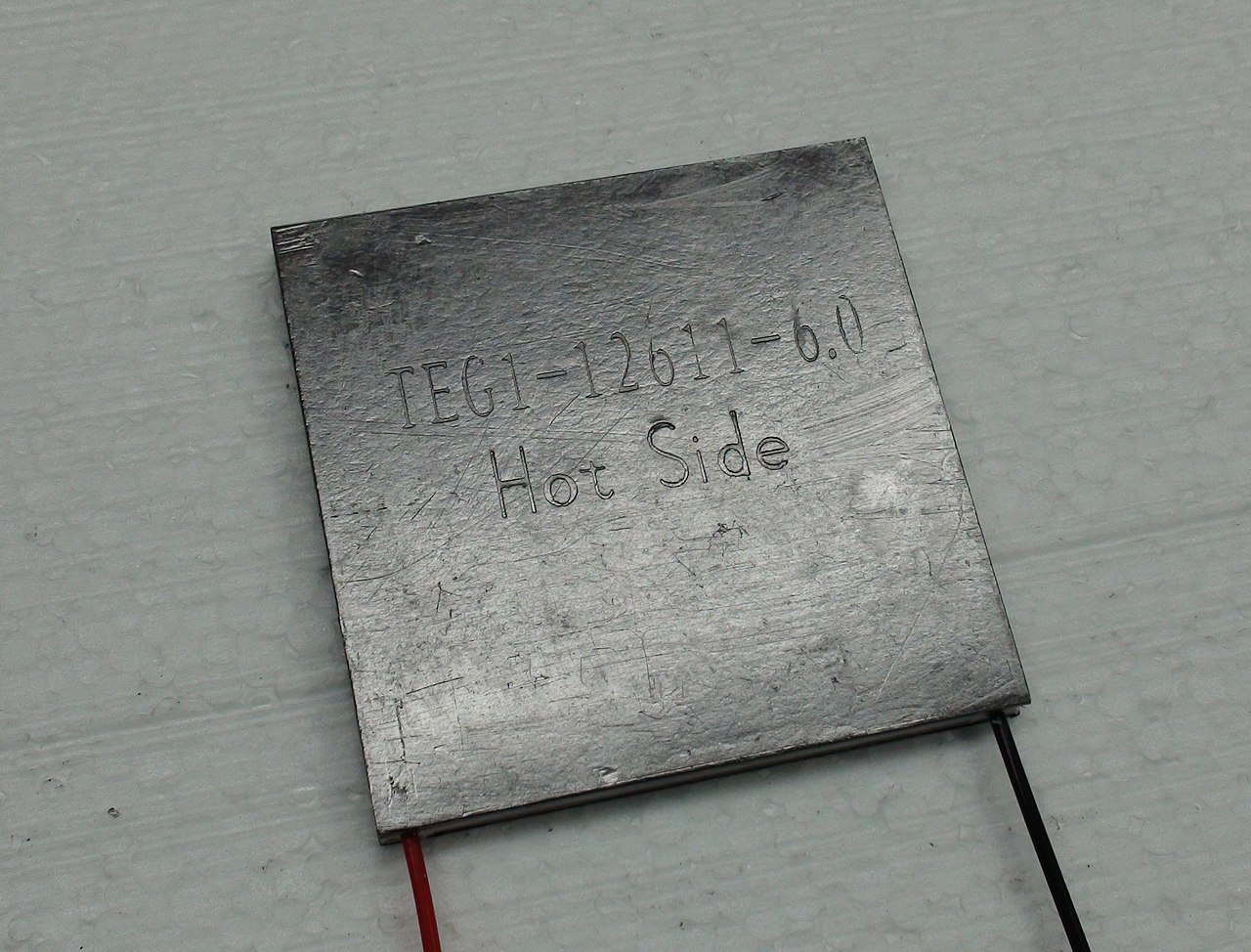
The Thermoelectric effect (TE) comes in two variants:

- The Seebeck effect makes it possible to turn a heat flow (based on a temperature difference) into electric power.
- The peltier effect does the reverse: it turns an electric current into a temperature difference across the two sides of the device.
The fundamental mechanism is a p-n-transition. So you have two different semiconducting materials, which means that the electrons are on different energy levels on both sides. When the electrons move from one side to the other, they have to absorb energy from the environment to get on the higher energy level themselves (p->n transition), or they give off energy (n->p transition), thus cooling or heating the environment.
With this technology, it is possible to build solid-state heat pumps that generate a temperature difference from an electric current with no moving parts! (i don’t know about efficiency or cost)
some people have pointed out that they’re less efficient the greater the temperature difference gets. so i wonder, what if you just take a bunch of them and “stack” them, i.e. put them one-after-another. they would be thermally in series but electrically in parallel, so the electric resistance doesn’t go up too much but the thermal resistance does. this is basically what you want. a low electric resistance but a high thermal resistance.
for this to make any economic sense they would have to be pretty cheap per-piece. that is why they should use the simplest possible manufacturing materials, such as doped silicon. we know from solar panels (PV cells) that those that eventually market-matured were using very simple materials (doped silicon) instead of the more rare and difficult-to-get germanium, gallium, etc.
there has been lots of research into more “efficient” (energy efficient) solar panels from german research institute fraunhofer institut, however it turns out that energy efficiency wasn’t what eventually made solar panels take off. the chemistry used today is still the simplest chemistry from around 2000, just scaled up enormously to take advantage of economies of scale. i think that peltier devices would have to be similar: simple doped silicon, no germanium etc., just very simple chemistry, mass manufactured to produce a lot of devices with cheap per-piece price, then just take a bunch of them and stack them behind one another to achieve greater energy efficiency.
deleted by creator