Because there is no Chinese campaign against data centers. China was simply pointing out the environmental and economic impacts data centers have on the areas around them.
Who is saying data centers are okay? They are not. And I do not even have any issue with LLM usage, yet I still recognize that data centers are incredibly resource-intensive and can have significant impacts on the communities that host them.
I think the predominant logic in the thread is that China trying to influence Americans against datacenters can’t be true because that could be an attempt to make a pro-datacenter argument, even though it’s not.
I think the logic is more noting that the pro-datacenter argument aligns with linking opposition to them to foreign actors.
Anti-China sentiment is extremely powerful to tap into, and the AI crowd absolutely is pulling out every stop to keep the bubble unpopped. Tapping into that energy for public opinion is the least surprising approach they could be taking.
I understand that it’s easy to believe someone could make this up to undermine anti-AI arguments. I don’t understand why it’s less easy to believe China would use social media to further their own goals - like everybody does. I mean, sometimes reality aligns with what somebody on the wrong team says.
Kevin O’Leary (Shark Tank) makes the same claim. He isn’t connected with OpenAI but is behind building a Utah datacenter, so he has no credibility either. The problem is, even if China really is doing this, nobody in the anti-AI community will believe it unless somebody points it out who is part of the community - just like with most other major issues. The Information Age has turned out to be a cluster of impenetrable echo chambers.

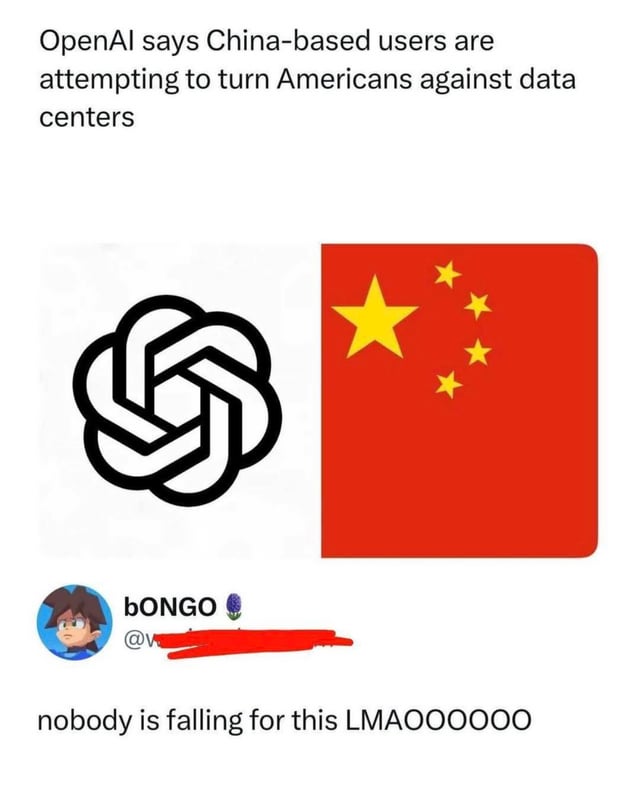
Because there is no Chinese campaign against data centers. China was simply pointing out the environmental and economic impacts data centers have on the areas around them.
Who is saying data centers are okay? They are not. And I do not even have any issue with LLM usage, yet I still recognize that data centers are incredibly resource-intensive and can have significant impacts on the communities that host them.
I think the predominant logic in the thread is that China trying to influence Americans against datacenters can’t be true because that could be an attempt to make a pro-datacenter argument, even though it’s not.
I think the logic is more noting that the pro-datacenter argument aligns with linking opposition to them to foreign actors.
Anti-China sentiment is extremely powerful to tap into, and the AI crowd absolutely is pulling out every stop to keep the bubble unpopped. Tapping into that energy for public opinion is the least surprising approach they could be taking.
I understand that it’s easy to believe someone could make this up to undermine anti-AI arguments. I don’t understand why it’s less easy to believe China would use social media to further their own goals - like everybody does. I mean, sometimes reality aligns with what somebody on the wrong team says.
Oh, the reason for that is the claimant here is OpenAI. That’s why there’s this credibility hurdle in people’s reactions.
Kevin O’Leary (Shark Tank) makes the same claim. He isn’t connected with OpenAI but is behind building a Utah datacenter, so he has no credibility either. The problem is, even if China really is doing this, nobody in the anti-AI community will believe it unless somebody points it out who is part of the community - just like with most other major issues. The Information Age has turned out to be a cluster of impenetrable echo chambers.
It’s crazy that the idea that you should actually present evidence to support the accusation against China doesn’t even occur to you.